How it works
Learn it. Test it. Keep it.
A pile of practice questions is not a course. This is what happens between opening your first lesson and walking into the exam.
- 10questions on every concept
- 7/10to open the next one
- 3ways in: read, listen, answer
- Dailychecks on the vendor's exam guide
The loop
Four steps, repeated for every concept
A course is a few hundred concepts. Each one goes through the same short loop, so you always know what to do next.
-
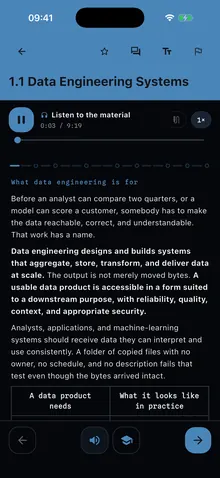 01 · Learn
Read it or hear it
Every concept is a short written lesson with narrated audio. On the page or in your headphones, it is the same material.
-
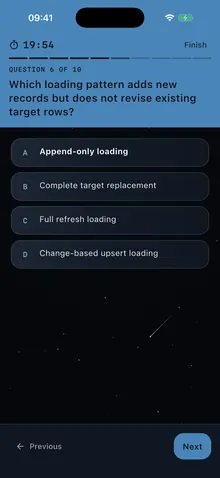 02 · Practice
Ten questions, right away
Score seven out of ten and the next concept opens. Miss it and you know exactly what to reread.
-
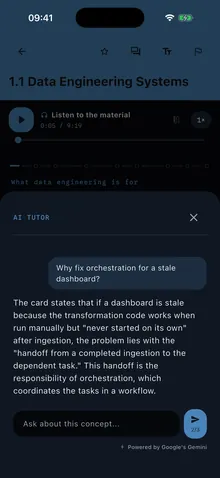 03 · Ask
Stuck? Ask the tutor
The AI tutor knows which concept you are on. It answers within your course, not about the cloud in general.
-
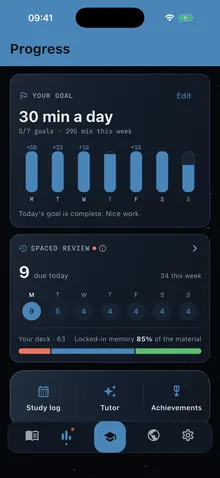 04 · Review
It comes back before you forget
What you got wrong returns on a schedule. Get it right three times in a row and it stops showing up.
When the loop is done, full mock exams are weighted by domain, like the real thing.
Rule one
Every question traces back to the source
We write with the vendor's current study guide open, and every claim is checked against the documentation before it reaches you.
Where most prep comes from
- A forum thread
- Someone's memory of last year's exam
- A syllabus that was right in March
Where ours comes from
- The vendor's current study guide
- The official documentation
- A new check whenever the exam changes
Wrong answers come from the same page as the right one. A distractor is a real value from the real documentation, altered. That is why practice feels like the exam and not like a quiz.
The mix
Ten questions per concept, on purpose
All easy leaves you overconfident. All hard wears you down. The mix tells you honestly where you stand.
Always current
When the exam moves, the content moves
Vendors add services, retire others and re-weight domains. We rewrite the concept that changed, not the whole course, and show you what changed and when.
- Official docsEvery lesson traces back to the vendor's current study guide and documentation.
- Checked every dayWe monitor exam guides and vendor docs daily.
- Updated in hoursThe lesson is rewritten and in your app in hours, not days.
The whole course, on your phone
Lessons you can read, audio you can listen to on the way to work, and practice that remembers what you got wrong.
“This app is the ‘One Lake’ for preparing the certification exams. Really worth it.”